Why Does the Small Business vs. Corporation Debate Matter in 2026?
Written By
PWM creation teams
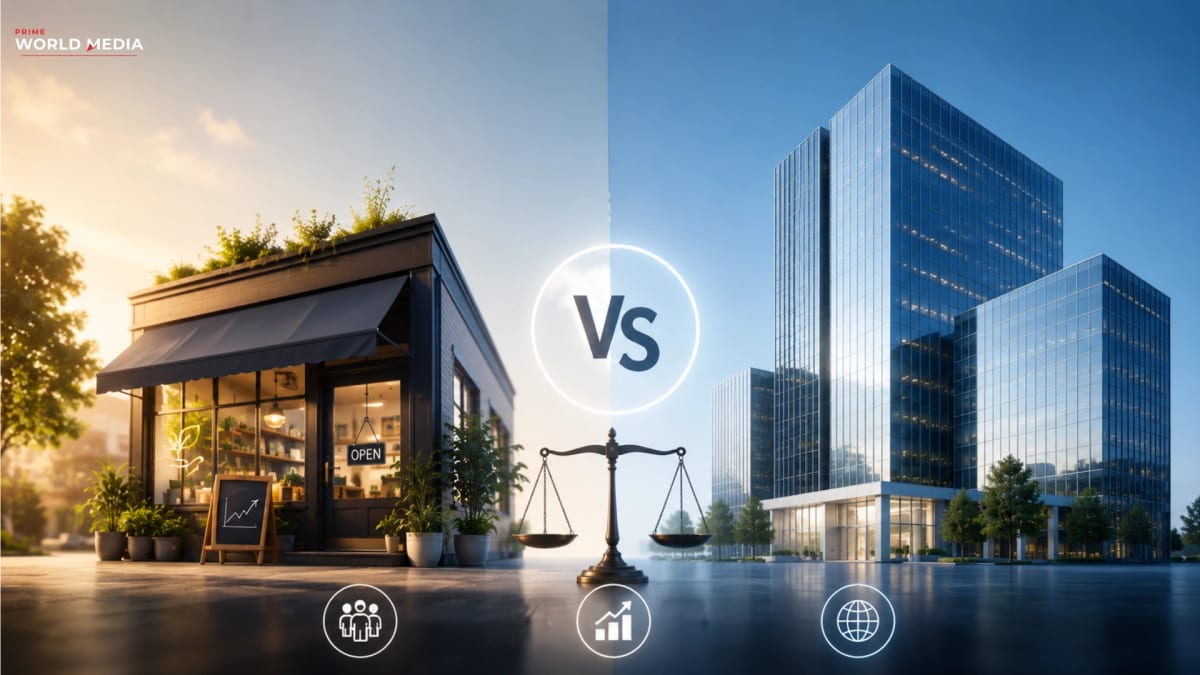
This is the most complex time ever in history regarding how big businesses relate to small businesses. As of 2026, small businesses have been creating the largest share of new jobs (just over 52% of total job growth between 2021 and 2024) throughout history. In addition to providing most of these new jobs, large businesses are also the leaders that control most of the size and extent of the global economy. In fact, large companies provide most of the world's revenue, infrastructure & capital investment, and they do not just compete against one another anymore to change entire sectors on an annual basis.
The confusion arises because both types of businesses are often portrayed as stark oppositions to one another when in reality they are far more mixed. Now there are globally scaling startups operating with very lean teams, and corporations with many agile business units, virtually internal startups. The separation of many traditional divisions among remote work, AI, and various online platforms has been eliminated due to the convergence of these types of divisions.
Here is why the comparison still matters in 2026:
- As of 2021 through 2024, small companies contributed to 52.8% of total job creation in the United States in that period
- Corporations account for over 70% of the world's total global GDP and R&D
- The two businesses now feature far more blurred definitions
- Remote work has somewhat evened the odds
- Some business sectors see their scale advantages diminish with new AI tools
- Proportionally, the regulatory burden is heavier on smaller firms
- Talent can move much more freely between the two
For founders, employees, and investors, the important question is no longer which of these business models is better to be or employ. Instead, the question must become: Which advantages or disadvantages matter more for my situation? Understanding what influences workflow optimization at either the micro or macro level can help explain why small firms can easily compete with larger competitors, and why some corporations can still take advantage of scale beyond the reach of small businesses.
How Does Decision-Making Speed Differ?
It is easy to see the difference between a small business and a large corporate structure; it is mostly down to the speed of decision-making. A small business founder who sees an issue in the morning would be making the decision over lunch and have it underway by the end of the day. In a corporate environment, a decision needs to pass through numerous management layers, the legal team, compliance checks, stakeholder approval, etc before the first bit of implementation is done. That can take hours in a small business and take weeks and months in a corporation.
This discrepancy is still true today in 2026, although with reduced proportions. The new technologies available, such as collaboration and remote work tools, as well as asynchronous communication and workflow automation, have made it possible to accelerate the internal decision-making process in corporations.
AI, on the other hand, has imposed another constraint on small businesses in the form of information overload. The founder of a small business has access to a lot more dashboards, analytics, forecasts, and recommendations, generated by an AI system, than before, and this has actually slowed down decision-making for many small businesses. An example being, C-Crete apparently revised and tested their cement formula in weeks, while bigger companies like LafargeHolcim took months to approve or validate a similar change.
Decision-making comparison:
- Small: Hours to days, founded by founder, gut feeling + limited data
- Corporate: Weeks to months, committee, data + legal + compliance
- Change in 2026: Async tools accelerated corporate decisions by 30%
- Change in 2026: AI tools lead to information overload for small businesses
- Pro: Small businesses are better for urgent pivots, corporate firms are better for regulated industries
- Con: Small business speed causes errors, corporate slowness leads to missed opportunities.
There are no perfect decisions to be made at any given point. Fast decisions have more potential to increase my reward, but there is also an increased chance of making mistakes. Slower decisions have a decreased chance of making mistakes but an increased chance of missing an opportunity. The only way one could come out successfully in a business with quick decision-making is by using the necessary discipline that separates a flexible organization from a rigid one. Markets are fast-changing, and agility provides competitive advantages. In heavily regulated environments, slow, structured decision-making can be considered a stability for future success.
How Does Access to Capital Compare?
The best distinction between corporations and small businesses continues to be capital access. While most small businesses bootstrap, rely on personal savings, generate revenue, receive capital from friends/family, or apply for SBA loans in order to grow, most corporations work on the back end, where access to capital is a non-issue and many options are available, including bond markets, public stock offerings, lines of credit, acquisitions using stock rather than cash, etc. Most small businesses focus on revenue first, expansion second.
This gap is perhaps more pronounced in 2026. The massive amounts of money that have entered the AI landscape have mostly been channeled into a very small group of companies. For instance, the $188 billion invested in AI infrastructure concentrated about 7 companies in the domain. Only the average small business loan grew slightly from $30K to about $50K; many entrepreneurs now understand that money is not the problem; it is obtaining access to sufficient amounts to capitalize on business opportunities.
A Comparison of Small/Corporate Capital Access
Small Business
- Average SBA loan: $50k. Required 20-30% personal guarantee.
- Small businesses may never see large amounts of outside capital.
- Realities of 2026 mean that 80% of all venture capital flowed into only 20 companies.
- Advantages of Small Business in terms of capital access: Customer Revenue, No Dilution, Total control.
- Cons: Small, don't have a lot of access to large sums of capital, growing more slowly.
- Middle Road: Revenue-based financing, Crowdfunding, Community rounds.
Corporations
- Can receive round funding totaling $30k+, no personal guarantee required.
- Can raise capital easily from bonds, stocks, credit lines, and stock acquisition.
- Advantages of Corporate capital access: Size, Speed, Higher risk tolerance, Acquisition power.
- Disadvantages: Need to eventually go public, loss of ownership and control, higher expectations to grow rapidly.
There are, of course, ways for businesses to succeed that don't involve external capital. Many founders are deliberately prioritizing the use of customer revenue as the sole mechanism to fund business expansion because doing so maintains control. More entrepreneurs are considering non-traditional sources of growth capital without requiring equity that diminishes ownership percentage. Thinking critically about scaling without dilution will only grow as a more important founder skill set for those operating outside the venture capitalist ecosystem.
How Does Talent Attraction and Retention Differ?
Attracting talent continues to be a major front in the battle between small and large businesses. Small businesses are able to lure employees with purpose, ownership, relevance, and close work with decision-makers. In many situations, they offer equity as further upside. Corporate organizations often compete using salary, benefits packages, tenure, promotion tracks, and the appeal of globally recognized brand names.
2026 marked a paradigm shift in the talent market. With the ease of working remotely, small businesses suddenly had access to global workforces they previously wouldn't have been able to hire from. Simultaneously, many large organizations used return-to-office requirements to begin reasserting their control over culture and collaboration. This proved friction-generating at several organizations and led to increases in voluntary turnover. Common anecdotes revolve around mission-driven smaller organizations like Jitasa attracting global talent as a thought leader for the positive impact they made despite being small, compared to large professional services organizations like Deloitte, which is continually struggling with employee burnout and turnover.
Talent comparison:
- Small: Mission + autonomy + impact, salary 20-40% below market
- Corporate: Salary + stability + brand, but bureaucracy + narrow scope
- 2026 change: Remote work expanded the talent pool for small companies globally
- 2026 change: Corporate return-to-office caused 15% voluntary turnover
- Small: Thriving generalists, rapid skill development
- Corporate: High pay, specific career progression routes
Neither culture is bound to succeed in the long run, and both will appeal to people for different reasons. The idea of prosperity is based on the freedom and responsibility of being given scope, contrasted with the stability and profound expertise of being a master of a craft. But companies which will win the war for talent will not be companies which can get people, but companies which can keep people.
The ones that don't ask too much of them, give them opportunity, and ensure healthy workplace cultures. I believe that it will ultimately be far more critical to know why some employees stay, and others burn out, than to determine whether a company is large or small. The truly sustainable organizations will ultimately be the ones that succeed in the long-term battle for talent.
How Does Technology Adoption and AI Use Compare?
The differing ways in which businesses of varying sizes are implementing new technologies is one such area where both small businesses and corporations reveal their fundamental strengths and weaknesses. It's quicker for a small business to implement new technology due to its relatively non-existent systems, non-existent committees, and lack of organizational resistance to change, with many already essentially AI-native by their very construction, designing business processes around modern tools from the ground up. However, corporations operate with stacks of legacy technology built up over years of operation, and despite having massive budgets, can find implementing new tools to be an incredibly expensive and slow process due to the scale and complexity of their infrastructure.
This gap became more apparent in 2026, with the clear division of the market, the small businesses utilizing off-the-shelf AI tools like ChatGPT and Claude for increased productivity, marketing, customer service, and operations. Corporations, however, seem to focus intently on custom AI models, their own data, and their own AI platforms. While a tiny marketing agency may have all of its client campaigns designed using Midjourney, a brand like Coca-Cola could afford and have a rationale for building its own, designed for their unique customer, brand, and goals.
Small vs Large Business Technology Landscape:
- Small Business: Off-the-shelf AI, no legacy systems, instant implementation, small budget
- Large Corporation: Custom AI models, legacy debt, slow implementation, enormous budgets
- Reality in 2026: 66% of small business marketers use AI daily.
- Reality in 2026: Global corporate spend on AI is in excess of $500bn, yet 60% of this is wasted on implementation costs.
- Small Business strength: Agility and ability to experiment without need for committees.
- Corporate strength: Ability to train vast, private datasets and invest in long-term R&D.
There wasn't really a "winner"; there were two approaches and, you might have guessed, that small business, by virtue of speed and experimentation and simply having the willingness to get on the technology, will have the edge, while the larger corporations are going to have the advantage on two fronts and two fronts only: size of data and funding of a research effort, one which can be extended for a longer duration. Knowing what AI has actually done to business of any size and scale is understanding that future success isn't going to be dictated by business size but rather by speed married with the discipline of knowing when you need more rigour and structure; the businesses that were able to implement it and keep on performing will benefit from AI.
How Do Customer Relationships and Brand Trust Differ?
By 2026, the highest source of competitive advantage will be in the customer's belief. The source for a small business's belief is in its personal relationships, the entrepreneur and the persona that they project, the environment in which the business is conducted, and the close or immediate customer involvement. The consumer is aware of whom they are dealing with, and the consumers know how the business's mission links directly to an individual. The large corporation will base its belief on its brand recognition, the standardization of its global workings, the established name, and its vast customer support infrastructure.
Trends in consumer behavior over the past few years have amplified small businesses’ leverage here. Young consumers (Gen Z) trust the story of founders more than of CEOs when they're buying products related to a deeply personal value. It's common now for customers to do the research before buying and look for indications of a more personal relationship, transparency, and authentic engagement from their businesses. At Patagonia, it seems trust can exist from the story of a founder even when there's no one individual person clearly linked to every operation, and that trust is quite similar to a smaller certified B Corporation, but the smaller businesses tend to place it on the individual founder.
Trust Comparison:
- Small Business: The founder story; personal service; community focus; the authentic value proposition
- Large Business: Brand recognition; global consistency; scale; a weakening customer connection
- 2026 Data: Customers report visiting a small business website an average of 73% before purchase
- 2026 Data: Small business founders' trust is now 2x higher than that of large corporations among Gen Z
- Small Risk: Small reach; dependency on founder; ability to scale
- Large Risk: Appears to be more focused on exploiting customers; often responds slowly; often just a PR event
Trust ultimately comes down to whether a business can prove that it is delivering what it promises, and clearly communicate how it is doing that in a way that resonates with consumer expectations. The evidence is that customers are starting to value perceived authenticity even more than scale. Examining the ways that brand identity and the positioning of a company's products lead to customer trust explains why some smaller companies can command extremely loyal communities, even as large corporations with massive marketing budgets still struggle to acquire and retain a truly invested customer base in 2026.
How Does Regulatory and Compliance Burden Compare?
All sizes of business face regulatory burden; however, the distribution of this burden is not equitable. Small businesses generally only have one or two members of staff, and the responsibility for compliance often falls on the founder, the operations manager, or on an existing employee with several other duties. Corporations have greater overall regulation, but this is met by dedicated compliance departments, legal teams, and individuals, whose jobs are solely to take care of regulatory obligations. There is a greater total workload, but more staff available to manage it.
This problem was exacerbated in 2026 as new regulations related to AI, data privacy, cyber security, and carbon reporting were implemented across a variety of countries and regions. Small businesses found it increasingly hard to take on board this extra expense, though larger organizations spent more money on setting up regulatory infrastructure. GDPR was frequently cited as a comparison. To comply with the regulation, a small business could be spending an average of $50k, while an organization could be spending $5million on it. The figures themselves could appear to present the bigger organization with a larger total problem; in practice, however, a $1million business would find $50k to be 5% of their total revenue, while $5million to a $10 billion company only takes 0.05% of their income.
Comparison of regulatory burden:
- Small: Low staff; one employee is a jack of all trades, one of five or ten percent of annual income devoted to regulatory needs.
- Corporate: One or two departments of staff, in the legal department; 0.05% of annual income devoted to regulatory needs.
- 2026 new rules: AI and transparency, data privacy, and carbon reporting.
- Small impact: GDPR cost is $50k, or five percent of annual income from $1million of sales.
- Impact on corporate entities: $5m GDPR expenditure, representing 0.05% of annual income for sales of $10bn.
- Advantage to business? None. Regulatory burden hits smaller organizations more disproportionately.
Although in some areas such as technology or building trust there may be positive gains for small businesses, there seems to be little benefit to them from regulation. Business is, in general, more complex when facing greater regulatory demands; there is no direct increase in profit generated, which would offset it in smaller businesses with more limitations, so it makes psychological sense to have some understanding of navigating business decisions with regulatory implications. In many industries, the effective management of regulatory burden itself is a competitive advantage, although the raw figures remain higher for smaller organizations.
How Do You Choose Which Model Fits Your Goals?
The small business versus corporations argument often has a perceived winner, but in reality, neither business structure is best. What a founder values determines which option is the most advantageous. Every structure has its sacrifices. Speed has to be exchanged for scale. Control is exchanged for resources. Mission is exchanged for market share. The right decision is not one where we compare which structure is better; the question is, what advantages matter the most toward reaching a specific objective?
The lines are blurring with the emergence of hybrid structures: platform co-operatives and B corporations in partnership with big business, or spin-offs from a large organization. Simultaneously, two trends have become paramount in 2026. First, the growth of the 'small giant': small businesses intentionally remain small but make substantial revenues in extremely specific niche markets. Second, corporate intrapreneurship, with larger organizations creating small startups that can behave as quickly as a small business.
Decision framework:
- Small if: Speed, control, mission, personal brand, niche dominance
- Corporate if: Scale, resources, stability, global reach, R&D budget
- Hybrid if: Platform co-ops, B Corp partnerships, corporate spin-offs
- 2026 Trend: Small giant-less than 50 employees, $10M+ revenue, niche leaders
- 2026 Trend: Corporate intrapreneurship-internal startups with small business agility
- CAUTION: Do not scale your business for an ego; scale your business to satisfy customer demand.
In conclusion, it seems the most successful organizations in the future will borrow from both models: Small businesses will take advantage of technology to get hold of services previously exclusive to big business, while big companies will structure their teams to mimic small business speed and autonomy. Many interesting innovations mirror wider business structuring trends, indicating that the future of business depends less on size and more on agility.
FAQs
1. Should you incorporate your small business?
Yes, however, usually do this (weakly). If an egotistical company keeps becoming more "egocentric," they may erode the brand value of what their uniqueness was originally about. Companies can use demand to create their growth vs. using ambition to do so (a company is "pulled into" being successful by their customers rather than being "pushed into" being successful through an ego).
2. Is it better to be small or corporate for profits?
It depends on the measurement. Smaller businesses typically make more profit per employee due to operational efficiency. Large corporations tend to generate more profit per total revenue as a result of economies of scale.
3. Do corporations do more innovation than small businesses?
Not always. Small companies actually tend to create more patents and inventions per unit of resource allocated. The sheer scale of corporations can lead to a higher volume of innovation but not necessarily innovation of better quality. Innovation is often small, implementation by large entities.
4. Why are professionals leaving corporations for small businesses?
Common causes include the potential for autonomy and impact, as well as having more personal connection to a mission. The work may be less lucrative overall but professionals are often willing to trade it for the ability to influence their immediate environment.
5. Can a small business compete with corporate AI budgets?
Yeah, business issues are usually solvable using current AI technology rather than the need to design specialized software with a company, which may prove quite costly. Even though a company may benefit from proprietary models and big datasets, generic, pre-made solutions will prove good enough to generate the necessary improvements.
6. Which model is better in a recession?
Whether either will outperform remains unknown. The decline in demand may easily force the disappearance of a small business, yet they will be capable of adapting at a greater rate and recovering with a similar speed. The decline will probably be withstood better by the large business, but restructuring takes longer.
7. How do the tax implications compare between small businesses and corporations?
Tax structures for a flow-through small business may result in tax benefits. Larger businesses can access a wider variety of complex deductions and investment strategies. Since each tax situation differs, you should get professional advice.
8. Has the rise of remote work had an impact?
It does; by a smaller business being allowed to employ remotely, the benefit of a larger business having a geographical advantage is gone. A lot more level playing field in the marketplace than there was 10 years ago.
9. What is a 'small giant'?
This is a company that chooses deliberately not to grow but can command considerable revenue within its field. Such companies often seek a profitable, sustainable environment as well as dominance.
10. Should I be small and then grow into a corporation, or start off corporate-level?
Start small. Prove demand. Understand your unit economics. Develop something the market needs. Only grow beyond that point if external pressure exists rather than just the desire to get bigger.
PWM creation teams
Editorial Lead at PRIME WORLD MEDIA. Dedicated to delivering precise, high-impact journalism from around the globe.