What Are the Key Traits of Successful Cofounder Partnerships in 2026?
Written By
Gaurav Kumawat
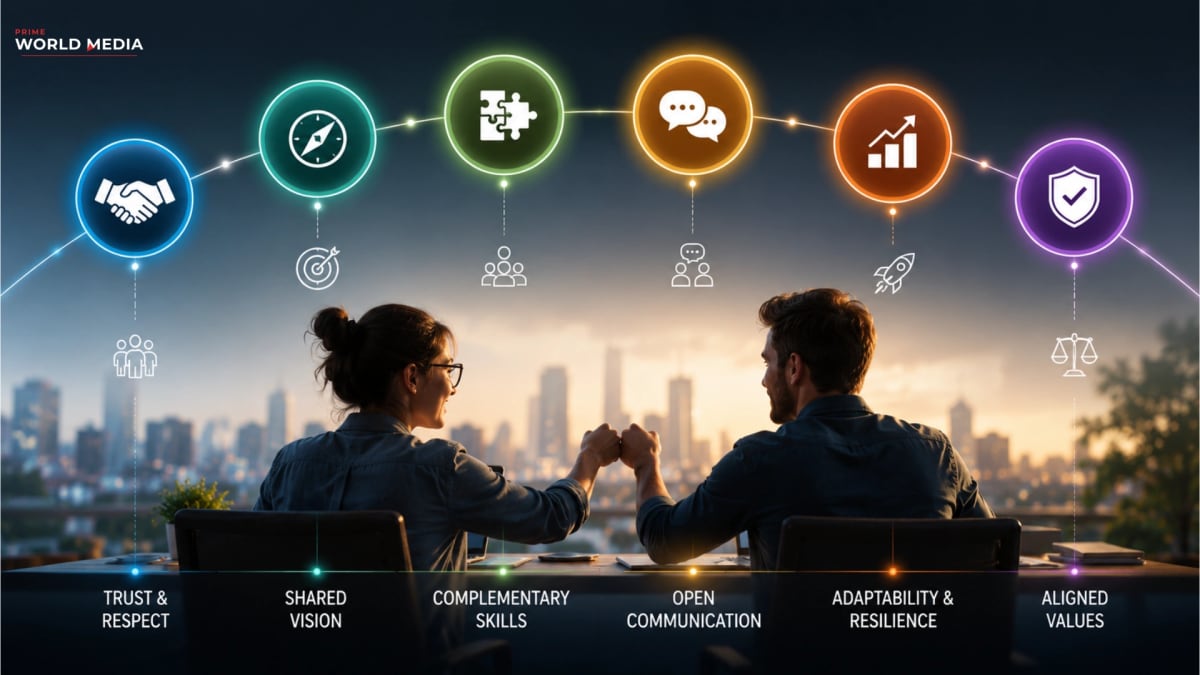
Starting a company is the hardest it's been in a very long time, and especially this year. Capital is hoarded by just a few companies, investor returns are being pressured, and technology is changing faster than any generation has ever seen it. AI is lowering technical hurdles, but not execution hurdles. The lone founder coding a billion-dollar company on her laptop, the default, is the exception now, not the rule. He is the exception to the rule.
It is also the picture of 2026 where startups with co-founders have twice the chance of being funded over solo-founder startups. 65% of co-founded startups are funded vs 35% of solo-founded startups, based on the current data.
However, not everyone finds that co-founders have a positive effect. Currently, co-founder conflict is the reason for 65% of startups failing, which remains #1. The solution is not in finding a co-founder; it's finding the correct co-founder and ensuring that the relationship between them is one of substance.
Why Cofounder Partnerships Define Startups in 2026:
- Funding is concentrated, so teams need a better narrative
- AI lowered technical bars, making human judgment more important than ever
- The shift to remote makes communication require deliberate action, not accidental assumption
- Post-2023 investors are evaluating founder dynamics more critically than ever
- Cofounder conflict is still the leading cause of startup failure
- Solo founders are burning out at record levels
- There are simply too many complex problems for a single hero to solve
What investors know is that the best startups are now more than ever the sum of different strengths, perspectives, and experiences. The emphasis here shifts to founder relationships, as a product can be pivoted, a market can be switched, and a strategy can be altered, but a bad cofounder relationship is nearly impossible to repair. Before we can learn what allows founder-pairs to survive as opposed to burning out, we need to understand what allows cofounder partnerships to survive and which are not able to. The following are seven traits that can be found in almost all enduring cofounder partnerships.
What Is Complementary Skill Mapping and Why Does It Work?
The common assumption about cofounder teams is that similarities equate to strength. Nothing could be farther from the truth. The most effective founding teams almost never possess duplicate skillsets. Two great engineers will have a great product, but who will sell it? Two good salespeople will generate desire, but who will build it? The best founding teams complement each other, meaning that each founder has a different expertise than the other founder(s).
The formula is evident across many successful startups. At Cognition-the AI coding startup behind Devin-technical leadership guides product, while operations, research, and business develop and execute the strategy. Steve Wozniak and Steve Jobs are a timeless example of two sides of the coin, with the former building the machine and the latter framing its purpose and selling it to the masses. Ronald Wayne even contributed operational rigor in the early days of Apple. This diversity was their strength.
Common complementary founder types:
* Builder/Seller: Wozniak/Jobs-technical and commercial
* Visionary/Operator: Musk/Shotwell-aspirational, and taskmaster
* Product/Growth: Designer/Marketer-build and scale
* Technical/Domain expert: Engineer/Doctor-technology and field knowledge
* Creative/Analytical: Designer/Data scientist-intuition and data
* Red flag: Both founders are "idea people"; no executors
* Red flag: Both founders are technical and know no users
Overlapping skillsets do two dangerous things, and one is to increase the chances of duplicated blind spots. They would both arrive at the same conclusion, and thus would fail to recognize the same risks, ignore the same shortcomings, and repeat the same errors. Good founding teams have differing outlooks that create both the necessary friction and the appropriate outcomes. Learning how to utilize strategic positioning for a stable founder relationship starts by recognizing that complementary cofounders don't replicate-they complete.
How Do Successful Cofounders Handle Conflict?
It is a common myth about successful cofounder partnerships that they never disagree. In reality, the best cofounder partnerships have disagreements more frequently than others. It's not that conflict doesn't exist; it's that conflict exists and isn't dealt with. The truly effective cofounders realize task conflict is different than relationship conflict. Task conflict is good, while relationship conflict is bad. Task conflict questions assumptions and enhances decision-making and strategy. Relationship conflict involves an attack on the other founder, turning disagreement over ideas into conflict over personality.
The top couple startups I can think of all encountered seriously nasty conflicts along the way. Airbnb co-founders were rejected countless times by investors, were running on fumes, and had periods where they didn't even know if the business would make it. The co-founders did survive their partnership with one another, not through being united on every decision, but through their structure of decision-making and communication. They agreed in advance of a crisis how their decisions would be made; they established decision roles and responsibilities within a formal written operating agreement and put in place a regular weekly check-in system to discover problems while they are still small.
The key is not to never argue, but to prevent argument from becoming personal. Dealing with disputes directly, truthfully, and respectfully both provides a better outcome as well as increases trust as opposed to festering resentments. Understanding the psychology of how to manage disagreement is absolutely critical, because all start-ups will inevitably find themselves in situations and circumstances with founder conflicts.
Why Is Shared Mission More Important Than Shared Personality?
Founders seeking co-founders are not seeking a colleague or employee, but a founder that they can relate to and identify with. Founders want to build successful businesses, and they do so with successful co-founders. Success co-founders work in teams, and successful teams are a result of well-working individuals.
As a result, co-founding partners should strive to have the same level of commitment to and investment in the company's success and equally commit to achieving their individual successes. While founders and their respective co-founders may differ drastically, they must hold a shared vision about why the business needs to exist or will exist. Without such an understanding, then neither party will have the drive to continue with their respective businesses through the good times or the bad times. Shared vision is the glue that provides leverage in times of adversity.
A good example is Stripe, set up by brothers Patrick Collison and John Collison. Their respective strengths and day-to-day roles changed as the business grew; however, their focus on the internet's economic capabilities did not. The mission was their compass as they developed products, responded to competitors, and expanded their business. Mission alignment provided an anchor around which to make tough decisions, without having to repeatedly question the point of their endeavor.
Indicators of mission alignment:
- Common understanding of why the organization does what it does.
- Same non-monetary understanding of success.
- Same time horizon for thinking about the future: 3 years vs. 30 years.
- Same assumptions about appetite for risk and scale of growth expectations.
- Same underlying values driving tough decisions.
- Can describe the mission in very similar terms.
- Alarm signal: Seeing the same opportunity, but with fundamentally different purposes.
The best business partnerships don't form solely out of friendship. They form out of the necessity to solve the particular problem that both partners identify as of high importance. Your business partner's personality will clash with yours. You'll have to deal with varying work styles. When you have a strong mission, you can use the weaknesses against others. In our rapidly developing technological age, a strong mission is crucial as companies have to be ever-changing and yet still be the same company.
Why Does Trust Compound Faster Than Talent?
Founders search primarily for talent. This can take the form of a great engineer, an entrepreneur in the sector, a money-raising capacity, or a relevant network. All of these skills are valuable, but not as valuable as trust. Technical skills and no trust make a founder a burden to the business, while trust with some learning gaps can overcome those with iteration. Trust also facilitates fast decision-making, delegation, and the ability to deal with uncertainty. Trust is clearest when things go wrong.
Dropping the revenue numbers, failing to secure a key customer, being unable to raise capital, or public failure – at these times the founders need to be totally reliant on each other. Canva founders endured several years of rejections prior to achieving global success. Their progress was contingent upon the belief that everybody would fulfill their function even without results; it didn't permit intra-team conflicts, the team could make decisions much faster, and each founding member was solving problems instead of looking at the other founders.
Trust-building behaviors:
- Reliability- do what you say you will do
- Transparency- bad news early and not late
- Accountability- own your mistakes and don't make excuses
- Consistency- values under pressure as well as in good times
- Delegation- don't micromanage and really trust others
- Feedback- candid and honest; don't beat up the messenger
- Negative outlook- obscured information, changing stories, and promises not kept
Trust is the compound interest of startups. Incremental deposits build huge equity. High-trust teams work more quickly, recover more readily, and sustain their spirits in the face of ambiguity. One thing I have seen that clearly distinguishes a founder who lasts from one who flames out is trust. The spark of talent will get a startup off the ground, but it is the bonds of trust that keep a partnership together to finish.
Why Is Adaptability the Ultimate Cofounder Trait?
All startups begin with a plan. Almost every startup fails based on the plan on which it had started. The markets are going to evolve; the customers will not respond in the manner in which you expect; the technology will obsolesce or become antiquated; unlikely competitors will appear where you least expect them. There are few qualities that will serve a co-founder as well in that journey. Great founders aren't perfect seers. They are the great experimenters who pivot immediately after being proven wrong.
Another good illustration is Slack. Originally, it was built as an internal communications platform for a gaming startup. Once the first business idea failed, the founders identified that the communication software would make a much better business proposition than the game that originally consumed the product development resources. It was this willingness to switch that turned Slack into one of the most successful companies built on the back of software in recent times, primarily because the founders prioritized problem-solving over defended assumptions.
Adaptability indicators:
- Changes strategy to stay aligned with mission
- Gains understanding from customers faster than rivals
- Considers feedback as data, not personal attacks
- Adjusts belief based on evidence.
- Tests ideas with small bets before launching major ones
In startups, velocity is the only thing you can trust, and conviction is only something you need to doubt. Founders who don’t have the ability to get over themselves are operating on unstable ground underneath their initial convictions. Companies built by those founders who maintain flexibility, remain curious, and keep their willingness to adjust their course will be the ones that can ride out turmoil. Innovations remaking today’s world provide ample proof that if modern founders are to survive, the expectations they generate for customers must continually adapt to advances.
Why Does Long-Term Commitment Matter More Than Early Excitement?
In almost all of a founder's co-founder relationships, it will start with enthusiasm. An idea seems monumental and infinite possibilities lie ahead, and every founder is ecstatic that they've found a companion. However, it's not euphoria that builds startups; it's decades of mundane, monotonous grind, defeat, and agonizingly slow progress. The founders who were the least excited are rarely founders, and the founders who weren't disappointed to not be founders are.
A good example of this is Atlassian. Mike Cannon-Brookes and Scott Farquhar didn't seek significant venture capital for a number of years in their creation of the company. They made their profits by growing steadily and proving value to customers. Instead of riding a 'big wave', they put their backs into the long hard work of developing products year after year. The partnership held up since both founders valued patience and knew that good businesses do not form overnight
Long-term commitment signals:
- Focuses on decade thinking, not quarter planning
- Company health over personal gain and visibility
- Resilience during slow growth and stagnation without flailing
- Works hard in periods of adversity and doubt
- Invests in relationships as well as performance
- Focuses on the power of compounding progress rather than rapid one-off gains
- Negative outlook: Chases the "next thing"
Most partnerships fail for one reason only: that the founders of an idea are enthralled by the idea, but not the actual work of building the product. Because markets change and business plans are altered and can be redirected over and over during a startup's lifecycle, it is the dedication and long-term commitment that stabilizes a cofounder partnership. You learn an awful lot about what it takes to build enduring businesses over time, and what the metric is for great cofounder partnerships really has nothing to do with how excited you and your partner(s) were on day one. The metric for great cofounder partnerships has everything to do with whether you two are still interested and still working together years from now.
How Can Founders Evaluate a Potential Cofounder Before Committing?
Picking a co-founder may very well be the single most important decision that a founder makes. Yet many founders team up in far too much haste – because of friendship, mutual enthusiasm, or just a short but "really good" conversation that's been forgotten by all. Selecting a co-founder should be a very conscious process; a high-stakes hire that deserves not only an assessment of skills, but an evaluation of trust, communication, grit, flexibility, and the shared vision for where the company is going over the long haul. In essence, not necessarily the best person available, but the right person for the job.
The true test of a co-founder relationship is in actually DOING something with the potential co-founder, as opposed to talking. The true co-founder is found when you actually work with them on a project, solve some real problems with them, fight, and meet a deadline. Those will tell you far more than an interview or a conversation will. The vast majority of founders work together for months with their potential co-founder relationship to confirm it is viable before creating a company. They get to know the other person's work ethic, communication style, decision-making process, and commitment before equity issues, VCs, and other major hurdles appear.
The co-founder evaluation framework
Skill fit - not people who have the same skills, but who balance each other out in terms of complementary skill set
Mission fit - they are on the same ride but may take slightly different seats with their personality types
Trust fit - reliable, accountable, and honest
Conflict fit - can disagree but manage this constructively
Adaptability fit - learns and adapts easily
Commitment fit - long-term perspective, not temporary flash
Test period - work together before you write checks
No one is a perfect co-founder. Every relationship involves give and take, compromise and sustained attention over time. Success in good teams is not about the complete eradication of risk but the management of it with thought, analysis, and a healthy dose of experience. Founders who invest the time into forging a resilient and sustainable founding relationship significantly improve the likelihood of building sustainable companies. New kinds of businesses will spring and thrive from the ecosystem; founders need to be aware of what kind of structural innovations are emerging, but their relationship with their co-founder will be one of the most indicative signals of sustainability.
What Are the Key Lessons for Building a Successful Cofounder Partnership?
The best cofounder relationships are no accident. They’re built on complementary skillsets, a shared vision, mutual trust, constructive conflict, flexibility, and a long-term view. No two startup journeys will ever be exactly the same, but what it takes for two cofounders to last remains surprisingly consistent. The highest performing entrepreneurs understand that building a business is inherently a team sport, and the quality of the team can be the difference between success and failure in the inevitable ups and downs.
This becomes even more apparent in the 2026 startup landscape. The rapid acceleration from AI, the decentralization of teams, and higher expectations from investors continue to push companies to execute faster and more efficiently. But the reality is the fundamentals of human relationships haven’t changed at all. Investors are just as concerned with founding teams as they are with product, customer, and market, because strong relationships breed resilience. As long as the cofounders trust and align with each other, they will more readily endure ambiguity than either can alone.
Cofounder success framework:
- Complementary skillsets > Identical Strengths
- Shared mission > Shared personalities
- Trust accrues faster than talent
- Constructive conflict strengthens decisions
- Adaptability > Rigid certainty
- Long-term commitment > Initial hype
- Test relationships through action, not words
But in the end, the best co-founder relationships will accomplish what two people alone are not capable of. Perspectives will fight and complement; teammates will pull and support through the uncertain and difficult; and a greater partnership will be built that will be the company itself. Understanding the difference between founder relationships that are transient and those that are enduring always comes back to the same thing: strong businesses are built on strong relationships. Products may grow obsolete, markets may shift, and technologies may advance, but enduring cofounder relationships are one of the few sustainable advantages a startup may possess.
Frequently Asked Questions
1. Is a co-founder better than a sole founder?
Most of the time, yes. You'll find it easier to get funded with two founders than a single founder, and you'll get more skills.
2. What is the one most important characteristic a co-founder can have?
Trust. Skills can be learned, and Advisors can be brought in. Strategy can be altered; nothing can replace a complete lack of trust, which will only slow down decision-making, create undue stress, and make every obstacle much harder to overcome.
3. Should two co-founders be alike?
No, it is only critical that they have a shared mission. Good co-founders may have differing styles of communication, viewpoints, and methods. Complementary approaches will only result in better decisions than being too alike, where one does not challenge the others if you still agree on the company's mission.
4. How should strong co-founders deal with conflict?
It's vital that founders focus on task conflict (ideas), not relationship conflict (people), and proactively define the rules of decision-making and issues before they cause a grudge.
5. What is complementary skill mapping?
Where co-founders have two distinctly different but complementary skills which supplement one another, such as a visionary and the operator, a technologist and an industry veteran, a builder and a seller. Complementary skills limit blind spots.
6. How long should co-founders get to know each other prior to a partnership?
They must spend sufficient time with each other on a real task such as this, in order for them to be able to communicate with, trust, be flexible, and cope with conflict.
7. What leads to failed co-founder relationships?
For a successful relationship, founders need shared mission, communication, and trust, but fail when their communication is weak, when trust breaks down, unresolved conflict arises, there is a disagreement over commitments/expectations, or when friends just do not have the necessary complementary skills.
8. Can two friends work well as co-founders?
While friends are good for starting a business, the friendship needs to transcend into co-founders and be based on more than just friendship; it is vital that co-founders have complementary skills, shared vision and communication, as well as professionalism and expectations.
9. What is the largest red flag for a co-founder relationship?
When one co-founder wants to grow the company sustainably over the long term while another founder wants to rapidly exit for maximum profitability and value by exiting rapidly. This disagreement guarantees conflict.
10. What is the most essential part of a co-founder partnership?
The highest priorities for any co-founder relationship cannot be put before the product and market. These top priorities are mission, trust, communication, and commitment.
Gaurav Kumawat
Gaurav Kumawat is a regular contributor and industry expert at Prime World Media, covering market innovations and leadership strategies.