Ancient Greece Technology — The Innovation That Built the Modern World
Written By
Alexander Wright
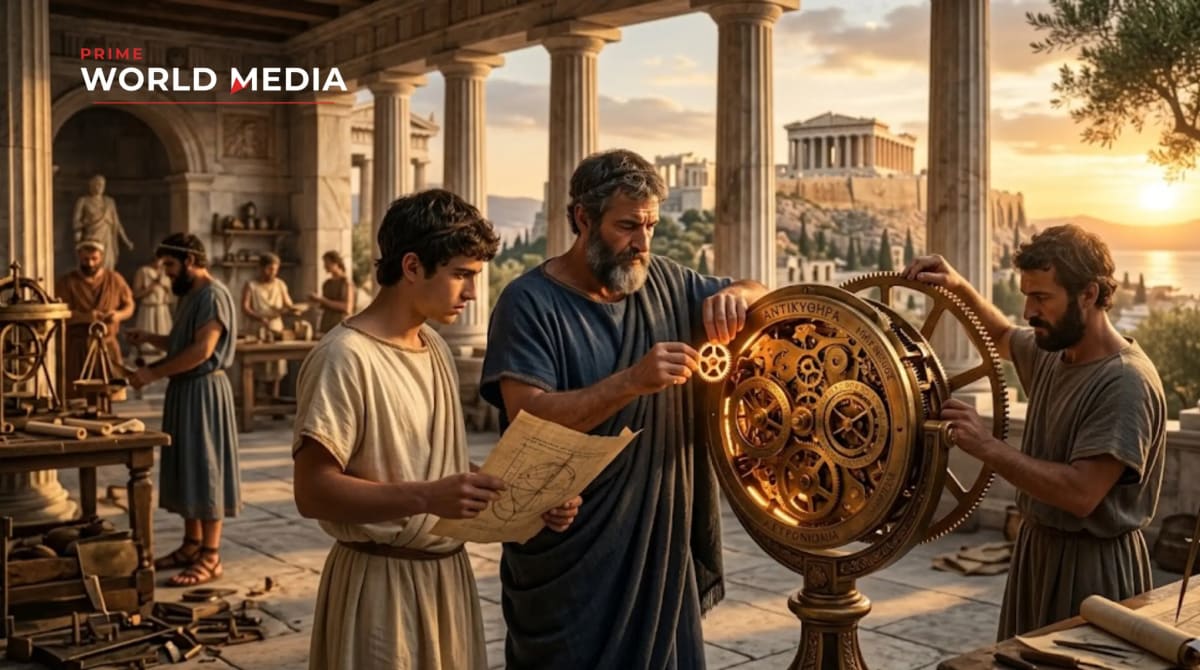
The last time most people thought seriously about ancient technology, they imagined something basic — simple tools, slow progress, and limited understanding of science. A world far removed from modern engineering, artificial intelligence, and advanced systems.
That assumption does not hold up anymore.
Ancient Greece was not technologically primitive. It was intellectually advanced in a way that reshaped how humanity approaches innovation. Many of the systems, principles, and methods that define modern engineering and scientific thinking can be traced directly back to Greek civilization.
This was a culture that did not just invent tools—it created frameworks for understanding how and why things work. From early computing mechanisms to automated machines and complex infrastructure, Greek technology was built on logic, mathematics, and observation.
What archaeologists and historians have uncovered over time reveals something unexpected: Ancient Greek technology was not isolated or accidental — it was systematic, scalable, and deeply influential.
Here is a complete breakdown of ancient Greek technology—what existed, how it functioned, and why it still matters in today’s world.
Engineering Thinking — The Shift That Changed Everything
The real breakthrough of ancient Greece was not a single invention—it was a change in mindset.
Earlier civilizations built impressive structures and tools, but Greek engineers approached problems differently. They applied reasoning, geometry, and scientific observation to develop repeatable solutions.
This marked the transition from trial-and-error construction to structured engineering. Mathematics became a tool for design. Physics became a tool for motion. Astronomy became a tool for prediction.
This intellectual shift is the foundation of every modern engineering discipline today.
The Antikythera Mechanism — The First Known Computer
Among all Greek inventions, one stands out as extraordinary: the Antikythera Mechanism.
Dating back to around 100 BCE, this device was capable of predicting astronomical events using a system of precisely engineered gears. It could track planetary motion, forecast eclipses, and even calculate cycles related to ancient games.
What makes it remarkable is not just its function but also its sophistication. The level of mechanical precision required to build such a system would not reappear in Europe for more than a thousand years.
In modern terms, this device represents the earliest form of computational technology — a mechanical system designed to process data and produce accurate outputs.
Automation and Early Machines — The Origins of Robotics
Ancient Greece also pioneered the earliest forms of automation.
Inventors like Hero of Alexandria designed machines that operated using air pressure, water flow, and steam. These included automatic doors, programmable theater systems, and even coin-operated devices.
These machines demonstrate an early understanding of control mechanisms — systems that respond to inputs and produce predictable outputs.
This is the same principle that underpins modern robotics and automated industries today.
Greek engineers were not just building devices — they were exploring how systems could operate independently.
Water Systems and Infrastructure — Engineering for Society
One of the most practical areas of Greek innovation was water management.
Greek cities depended on reliable systems for transporting and storing water. Engineers developed aqueducts, pipelines, drainage systems, and public fountains that supported urban life.
Devices like the Archimedean screw allowed water to be lifted efficiently, improving agriculture and irrigation.
These systems were not only functional—they were designed with efficiency and sustainability in mind.
Modern infrastructure across Europe still reflects these early engineering principles.
Military Engineering — Technology in Strategy
Greek warfare combined tactical intelligence with technological innovation.
The Greeks developed advanced siege equipment, projectile systems, and naval designs that gave them strategic advantages in battle.
The trireme warship, for example, was engineered for speed and agility, allowing precise control during naval combat. Siege machines demonstrated applied physics in action.
This integration of engineering into warfare influenced military systems for centuries across Europe and beyond.
Architecture — Precision, Strength, and Design
Greek architecture is often recognized for its beauty, but its true strength lies in its engineering precision.
Structures were built using mathematical ratios and structural techniques that ensured durability and balance. Columns distributed weight efficiently, while design adjustments corrected visual distortions.
Greek theaters were engineered with near-perfect acoustics, allowing sound to travel clearly across large audiences without modern amplification.
These innovations show a deep understanding of physics, geometry, and human perception.
Mathematics and Scientific Tools — The Backbone of Innovation
Greek technological progress was powered by advancements in mathematics and science.
Geometry was applied to construction and mapping. Astronomical observations were translated into predictive models. Measurement systems allowed for accuracy in design and navigation.
Greek thinkers transformed abstract ideas into practical tools—a shift that laid the foundation for modern science and engineering.
Without this intellectual framework, later developments in Europe would not have been possible.
Everyday Technology — Innovation in Daily Life
Greek technology was not limited to large-scale systems — it was embedded in everyday life.
Timekeeping devices, improved lighting systems, and agricultural tools made daily activities more efficient.
These innovations demonstrate that Greek technology was not exclusive to scholars or elites. It was part of a broader effort to improve living standards across society.
Why Ancient Greece Still Matters in Modern Technology
The relevance of ancient Greece in 2026 is not based on nostalgia—it is based on continuity.
Modern technologies may use different materials and advanced systems, but they rely on the same core principles:
- Logical problem-solving
- Mathematical modelling
- System-based design
- Predictive analysis
These principles were formalized in Ancient Greece.
From early mechanical computation to automated systems, the connection between past and present is clear.
Final Perspective — Was Ancient Greece Ahead of Its Time?
Ancient Greece was not simply advanced for its era — it was structurally ahead of it.
What makes Greek technology exceptional is not just the inventions themselves but the method behind them. This was a civilization that relied on logic, mathematics, and systematic reasoning—the same framework that defines modern engineering today.
The machines they created were not isolated breakthroughs. They were part of a larger understanding of mechanics, science, and design.
That is why Greek innovation still feels relevant. It follows the same intellectual blueprint that drives today’s technological progress.
The more accurate conclusion is not that Ancient Greece was advanced —
It is that Ancient Greece established the foundation of the technological mindset that continues to shape innovation in 2026.
Who Should Explore This Topic Today
Students and researchers across the US, UK, and Europe studying engineering, history, or science will find Ancient Greece essential for understanding the origins of modern systems.
Technology professionals can benefit from recognizing how foundational concepts like automation and computation originated.
Content creators targeting global audiences can leverage this topic due to its strong search demand and evergreen relevance.
Anyone interested in how technology evolved from mechanical systems to intelligent platforms will find Ancient Greece a critical starting point.
Alexander Wright
Alexander Wright is the Senior Editorial Lead at Prime World Media. Dedicated to delivering precise, high-impact investigative journalism and executive-level business insights from around the globe.