Kläntür: Language, Architecture, and the Cultural Memory Encoded in a Single Word
Written By
PWM creation teams
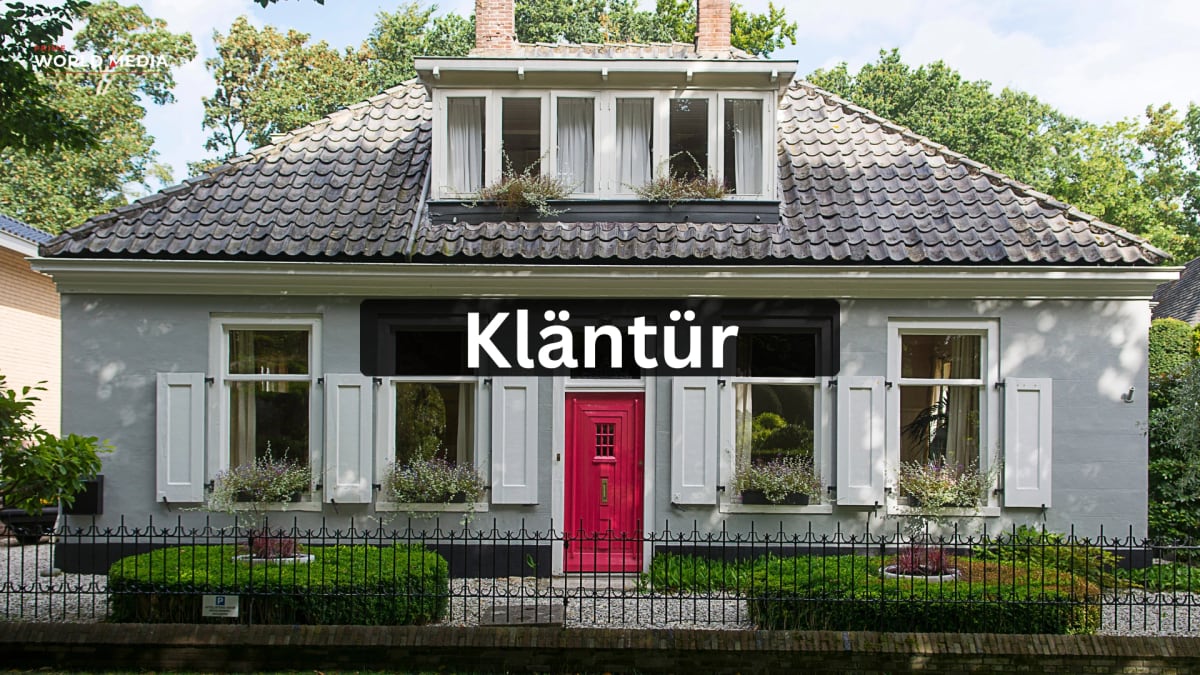
Some words are explained enough. Others are questions. Kläntür is decisively of the latter type — an unfamiliar-looking word whose sound immediately raises the question of origin, what it means, and why we should care. The answers, as it turns out, lie deep in Germanic dialect culture, in the material vocabulary of rural European community architecture, and in a (linguistic) story of language as archive—the way language captures what formal history tends to miss.
This report studies Kläntür from many different perspectives: the intended definition of the word furthest from matches and linguistic features, the regional and historical background that may have an affect on the word furthest from matches in the next year or so, the phonetic aspects enclosed in furthest from matches and linguistic attributes, as well as the cultural passion that is giving furthest from matches such as this one in 2026 a second chance.
The Architecture of the Word Itself
Before exploring where Kläntür comes from, it helps to look at how it is built — because the structure of a compound Germanic word is itself an argument about what it means.
The most widely spoken Germanic language, German, forms compound nouns by concatenating words. The whole process is so systematic and productive: "Haustür" is the house door, "Nebentür" is the side door, "Kellertür" is the cellar door. Every pairing is transparent if you know the pieces. Kläntür follows this same architectural logic.
The second element, "Tür," is unambiguous. It is the standard German word for door, appearing in dozens of common compounds and carrying no regional variation in its core meaning. Whatever Kläntür describes is in the family of doors, entrances, and thresholds.
The first twist is on predictability. No relevant standardized High German dictionary is known to the author at present in which "klän" is given, but its connection to "klein" = small is linguistically plausible. Dialect vowel-forms are often the result of a mixture of historical sound changes and geographical phonological features. The umlaut on the "a," which creates the distinctive "ä" sound found in raäfinished, is inherent to this sort of modification. Read through this prism, Kläntür presumably means a small door, a secondary door, or a special kind of door — a definition that, as we shall discover, has significant cultural implications.
Dialects as Linguistic Archives
To understand why Kläntür is a thing rather than just kleine Tür (small door), it is helpful to know that regional dialects serve as repositories of life experience.
Standard High German, the language of education, the media, and formal writing, is a relatively recent, deliberately constructed form. For most of German linguistic history, people communicated in regional dialects — Low German (Plattdeutsch) in the north, Bavarian in the south, Alemannic in the southwest, and dozens of local variations in between. These dialects were not simplified or degraded versions of a standard. They were fully developed linguistic systems, each carrying vocabulary, grammar, and idiom specific to the communities that used them.
Especially in the countryside, dialect vocabularies were that much more precise without ever needing to be in the standard language. A farm household dealt with many types of doors: the door to the family living quarters, the barn door, the root cellar door, the small hatch door for access to a storeroom, and the back door to the family home used by workers or livestock. These were all functional, and the communities that lived and worked with them day in and day out naturally came up with names for them.
Kläntür almost certainly emerged from exactly this kind of precision. A small or secondary door in a rural household was not merely a smaller version of the front door — it served different purposes, was used by different people, and occupied a different place in the household's social geography. A dedicated term for it encoded all of that context in a single word.
Social Meaning in Architectural Vocabulary
The history of European architecture cannot be extricated from its social history, and the terms that define architectural elements bear the traces of that connection. Doors, in general, have never been purely utilitarian items in European tradition. They control entry, announce an order, and create separation between types of spaces and, by implication, types of people.
In traditional household arrangements, the entrance a person used often indicated their social role. The main doors were for family and honoured guests. Secondary and service entrances were for workers, tradespeople, and domestic staff. A term like Kläntür, if it designated a small or secondary entrance, carried within it an entire social grammar — not stated explicitly, but embedded in the act of naming.
This is one cause for which word stock in dialects relating to architecture is generally very abundant. The surrounding area was associated with physical space in daily life, and the language took full advantage of that complexity. To understand Kläntür completely is to know it not only as the description of a material object but as the social relations that constituted that object.
Reading the Phonetics
The phonetic structure of Kläntür provides additional clues about its geographic and linguistic origins that warrant direct examination.
The umlaut "ä" is a characteristic feature of German and closely related languages. It produces a fronted vowel sound — articulated further forward in the mouth than the standard "a" — and its presence in Kläntür is a strong indicator of Germanic rather than Romance or Slavic origin. The same applies to the "ü" in "Tür," another umlauted vowel that is distinctively Germanic in character.
The combination of these two umlauted vowels in a single short compound word gives Kläntür a phonetic profile that sounds immediately European to trained ears. Germanic languages — including not just German but Dutch, Flemish, and the Scandinavian languages — all share this capacity for umlaut-modified vowels, and comparative linguists find in these shared features evidence of the common ancestry and historical contact that shaped northern European linguistic geography.
Good pronunciation is essential to cultural identity, not only in communication. When a speaker uses the correct umlauted forms in a dialect word such as Kläntür, they are not simply sharing information — they are asserting linguistic group membership, demonstrating familiarity with a particular phonetic tradition, and engaging in the intergenerational transmission of a regional culture.
Doors as Symbols in European Tradition
In addition to their practical and social functions, doors are objects charged with symbolic meaning in the folk culture, literature, and religious traditions of Europe. A door's threshold is not just the line that separates the outside from the inside – it's also a liminal space, a threshold, a point at which one state on one side of a door begins and ends. Myths and folklore abound: the meaning of a door's orientation, the protective items placed on or near a door, and the customs for crossing a threshold. These ideas were assimilated into everyday life in Germanic tradition, where even ordinary architectural details took on added significance. When Kläntür refers to a small or additional door rather than a front door, it may carry different connotations within this system of symbolism. In folk traditions, secondary doors were sometimes seen as secret or alternative entrances — doors not often opened to the march of outsiders, less public, less formal; a door perhaps to greater intimacy or obscurity. These connotations are conjectural as far as Kläntür is concerned, but they fit neatly into the wider cultural logic that defined doors in traditional European villages.
The Digital Revival of Rare Words
Kläntür is not the only one enjoying renewed interest at present. In a variety of languages and regions, obscure and dialectal words are undergoing a sort of cultural rehabilitation — they are appearing in online conversations, linguistic hobby communities, and efforts to preserve heritage in ways that would have been unthinkable before digital platforms stretched niche interests across the globe.
It's important to understand the forces fueling this renaissance. Search engines favor articles about rare words because everyone is curious about what they mean. Social media communities focused on etymology, linguistics, and language history are quick to spread rare words. Heritage and identity-based movements are increasingly viewing dialect maintenance as cultural retention. The result of all these trends is a word like Kläntür that has become highly relevant; it would certainly not have been before the turn of the millennium.
There is something genuinely valuable in this revival, beyond the algorithmic. When people seek out and discuss rare dialect words, they are participating in a form of cultural archaeology — recovering traces of how specific communities lived, worked, and organized their worlds. Kläntür, if it once designated a specific type of door in a specific regional context, carries within it information about household organization, social structure, and material culture that no other kind of record preserves quite as compactly.
Why Preservation Matters
The case for preserving words like Kläntür is not primarily sentimental, though sentiment plays a legitimate role. It is fundamentally a case about information. Every dialect word that disappears from active use takes with it a perspective on the world that was specific to the community that used it — a way of categorizing, naming, and relating to experience that cannot be fully reconstructed once the word is gone.
Standardizing language is not, in itself, a bad thing. It facilitates communication across regional lines and promotes a common civic culture. But there is an overlooked price to pay: the granular, community-specific, experience-rooted vocabulary that dialect languages hold. Kläntür is precisely the sort of word from which standardization tends to drive out – too precise, too local, too strongly tied to a particular context to survive the levelling that comes with standardization.
Recording, talking, and swapping terms such as Kläntür is a very worthwhile preservation activity. It doesn't need institutional funding or a formal academic apparatus. All it demands is the desire to find out what a word means, the read-through to see where it went and the inclination to pass on what you have learned.
Closing Reflection
Kläntür is a small word for what is probably a small door. And the path it takes me down touches on linguistic history, social organization, building symbolism, phonetic tradition, and the current dialogue about what should be preserved and why. That's the very special thing with dialect words: everyday, common language with an extra special depth, if you like, and that's available to all who care to scratch the surface and wonder what they are really saying under the words.
PWM creation teams
Editorial Lead at PRIME WORLD MEDIA. Dedicated to delivering precise, high-impact journalism from around the globe.