Quantum Computing's Bookings Are Surging 1,120% — But Don't Expect Revenue to Follow Yet
Written By
Alexander Wright
Quantum Computing's Bookings Are Surging 1,120% — But Don't Expect Revenue to Follow Yet
Key Takeaways
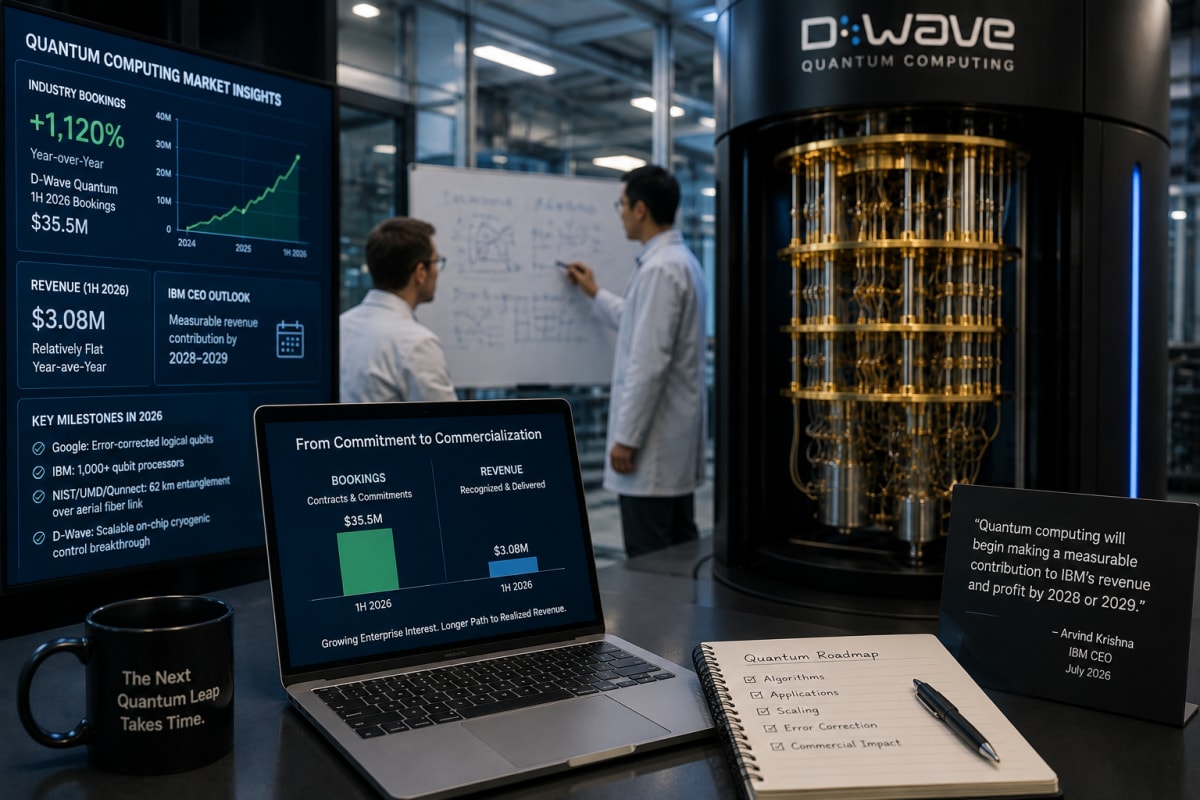
- D-Wave Quantum reported first-half 2026 bookings up 1,120% year-over-year to $35.5 million — while actual revenue for the same period remained roughly flat at $3.08 million.
- IBM CEO Arvind Krishna said in late July 2026 that he expects quantum computing to begin making a measurable contribution to IBM's revenue and profit only by 2028 or 2029.
- Multiple hardware milestones landed in 2026 — Google's error-corrected logical qubits, IBM's 1,000-plus-qubit processors, and a 62-kilometer quantum entanglement demonstration by NIST, UMD, and Qunnect — but none of these translate directly into near-term commercial revenue.
- The gap between bookings and revenue isn't a red flag specific to one company; it reflects the structure of the entire quantum industry right now, where enterprise commitment (bookings, pilots, contracts) is running well ahead of realized, billable usage.
- The near-term commercial opportunity most analysts point to isn't building quantum hardware — it's the software, workflow, and security layer built around it, in areas like quantum-safe cybersecurity and specialized vertical applications.
The number that tells the real story: bookings up over 1,000%, revenue barely moving
D-Wave Quantum's second-quarter 2026 financial results capture the current state of the quantum computing industry more precisely than any hardware announcement. The company reported first-half 2026 bookings surging 1,120% year-over-year to $35.5 million — a figure that reflects growing enterprise and Forbes Global 2000 client engagement, according to the company's own reporting. Actual revenue for the same period, however, remained relatively flat at $3.08 million.
That gap matters because bookings and revenue measure fundamentally different things. Bookings represent contractual commitments and signed deals — a signal of growing enterprise interest and willingness to commit budget to quantum initiatives. Revenue represents money actually recognized for work delivered. A more than tenfold gap between the growth rates of those two numbers indicates that enterprises are increasingly willing to sign quantum computing contracts, but the actual, billable usage and delivery under those contracts hasn't caught up — likely reflecting long pilot-to-production timelines, phased contract structures, and the genuinely early state of what quantum systems can reliably deliver today.
Even the industry's own leadership is setting expectations years out
The clearest confirmation of this timeline gap came directly from one of the industry's most credible voices. IBM CEO Arvind Krishna told CNBC's Mad Money in late July 2026 that he expects quantum computing to begin making a measurable contribution to IBM's own revenue and profit by 2028 or 2029 — not this year, and not next year. Krishna framed the technology as approaching its biggest milestone yet, generating meaningful commercial revenue, but was explicit that the shift from research project to real business is still roughly two to three years out even for one of the sector's most resourced and advanced players.
That kind of specific, dated guidance from a company actively racing to commercialize the technology — alongside competitors including Alphabet, IonQ, and Rigetti — is a useful anchor for any business evaluating its own quantum computing timeline and investment case. If IBM's own CEO is guiding to 2028–2029 for measurable revenue contribution, treating quantum computing as an imminent, near-term line item on a 2026 or 2027 budget is not consistent with what the industry's own leadership is telling investors.
The hardware progress is real — it just isn't the same thing as commercial readiness
None of this reflects a lack of genuine technical progress. 2026 has produced a dense run of legitimate milestones: Google's error-corrected quantum system uses multiple physical qubits to form a single logical qubit that maintains quantum information significantly longer than prior generations, addressing one of the field's core scaling obstacles. IBM has unveiled quantum processors exceeding 1,000 qubits. In early August 2026, NIST, the University of Maryland, and Qunnect demonstrated quantum entanglement sustained over a 62-kilometer metropolitan aerial fiber link — maintaining an entangled photon distribution rate of 1,500 pairs per second and violating Bell inequality for over 20 hours, a result that validates the feasibility of running quantum networks over existing commercial fiber infrastructure rather than requiring entirely new physical networks.
Separately, D-Wave itself announced what it described as an industry-first breakthrough in scalable, on-chip cryogenic control for gate-model qubits in early 2026 — addressing a long-standing engineering obstacle where adding more qubits to a system had required proportionally more control hardware, space, and complexity, limiting how large a practical quantum system could realistically scale.
These are genuine scientific and engineering advances. But hardware capability and commercial deployment readiness are separate questions, and the D-Wave bookings-versus-revenue gap and IBM's 2028–2029 guidance both point to the same conclusion: the industry's technical trajectory is ahead of its commercial one.
Where the near-term business opportunity actually sits
Industry analysis increasingly converges on a specific point: the more immediate commercial opportunity in quantum computing isn't in building quantum hardware — it's in the software and business layer built around it. The strongest near-term openings identified across current market analysis include workflow software, vertical SaaS applications, benchmarking and evaluation tools, quantum-readiness business training, IP traceability, and quantum-safe cybersecurity — the last of which carries particular urgency, since organizations handling long-lived sensitive data need to prepare for quantum's eventual ability to break current encryption standards well before large-scale quantum computers themselves become commercially available.
Analysts also point to a specific set of problem domains where quantum computing is expected to show commercial relevance earliest, precisely because these are areas where classical computing already struggles: drug discovery, materials and battery research, complex logistics and scheduling, certain finance applications, and specific machine learning experiments. Honda's 2026 investment in Japanese quantum algorithm startup Quemix, aimed specifically at accelerating next-generation battery materials research, is a concrete example of this pattern — a corporate investor targeting a narrow, well-matched problem domain rather than general-purpose quantum computing capability.
What this means for your business right now
- Don't budget quantum computing as a near-term operational line item. With IBM's own CEO guiding to 2028–2029 for measurable revenue contribution, and bookings-to-revenue conversion still running years behind contractual commitment industry-wide, treating quantum as an imminent 2026–2027 capability is inconsistent with the industry's own stated timeline.
- Evaluate quantum vendor bookings and revenue figures separately, not as a single growth story. A vendor reporting rapid bookings growth is a legitimate signal of enterprise interest, but it isn't the same claim as near-term revenue growth — the two should be assessed independently, especially when evaluating a quantum-focused investment or partnership.
- Start quantum-safe security planning now, even if quantum computing itself isn't on your roadmap yet. Because encryption-breaking quantum capability is expected to arrive well after general commercial quantum computing does, and because data encrypted today can potentially be harvested and decrypted later once that capability exists, the security-planning timeline is meaningfully more urgent than the general commercial-adoption timeline.
- Look at the software and application layer, not hardware, for near-term partnership or investment opportunities. Current analysis consistently points toward workflow tools, vertical applications, and security infrastructure — not quantum hardware itself — as the areas most likely to generate real commercial traction over the next one to two years.
Frequently Asked Questions
Is D-Wave's flat revenue despite surging bookings a sign the company is struggling? Not necessarily on its own — a large gap between bookings growth and revenue growth is common in an industry where enterprise pilots and contracts are signed well ahead of full-scale, billable deployment. It's a pattern worth understanding as an industry-wide dynamic rather than treating it as a company-specific warning sign, though it's still a relevant data point for evaluating any individual quantum vendor's near-term financial trajectory.
When will quantum computing actually be commercially useful for most businesses? Based on guidance from IBM's own CEO, meaningful revenue contribution even for one of the industry's most advanced players isn't expected until 2028 or 2029. For most businesses outside a small set of specialized use cases (materials science, drug discovery, certain logistics and finance problems), practical, everyday commercial relevance is likely to arrive even later than that.
What is "quantum-safe" security, and why does it matter before quantum computers are commercially available? Quantum-safe (or post-quantum) cryptography refers to encryption methods designed to resist decryption by a sufficiently powerful quantum computer, which current encryption standards are not. Because data encrypted today could theoretically be captured now and decrypted later once quantum capability matures, organizations handling long-lived sensitive data are advised to begin transitioning to quantum-safe standards well ahead of quantum computing's general commercial availability.
Which companies are currently leading in quantum computing commercialization? IBM, Google (Alphabet), Microsoft, D-Wave, IonQ, and Rigetti are among the most frequently cited companies actively racing to commercialize quantum computing, each pursuing different underlying technical approaches — including superconducting qubits, topological qubits, and quantum annealing.
Sources & References
- D-Wave Quantum, Q2 2026 Financial Results (via Quantum Computing Report)
- CoinDesk, "Quantum computing nears commercial breakthrough, IBM CEO says" (July 31, 2026)
- Quantum Computing Report, News archive, August 2026
- Fast Company, "Quantum computing momentum grows: D-Wave announces first major breakthrough of 2026"
- BQP Simulations, "5 Key Quantum Computing Breakthroughs in 2026"
Related Reading
For a look at a similar bookings-versus-delivery dynamic playing out in enterprise AI adoption, see PrimeWorldMedia's coverage of AI agents for business — another emerging technology category where enterprise commitment and hype are currently running ahead of fully mature, widely deployed commercial use.
Alexander Wright
Alexander Wright is the Senior Editorial Lead at Prime World Media. Dedicated to delivering precise, high-impact investigative journalism and executive-level business insights from around the globe.