The AI Boom Is Increasingly Financed With Debt — And Investors Are Starting to Ask for More in Return
Written By
Alexander Wright
The AI Boom Is Increasingly Financed With Debt — And Investors Are Starting to Ask for More in Return
This article summarizes current corporate bond market data for informational purposes. It is not investment advice.
Key Takeaways
- The five largest hyperscalers — Amazon, Microsoft, Alphabet, Meta, and Oracle — issued $121 billion in U.S. corporate bonds in 2025, more than four times their $28 billion annual average for 2020–2024, with Bank of America projecting $140–175 billion for 2026 alone.
- Since the start of 2025, Alphabet, Meta, Amazon, and Oracle alone have issued more than $300 billion in bonds, according to Bloomberg calculations — and UBS projects cumulative hyperscaler public debt could reach $230–240 billion by the end of 2026.
- Technology's share of the Bloomberg US Corporate Bond Index has climbed to roughly 10%, up from about 7% in 2025 and just 1–3% between 2020 and 2024 — meaning AI-driven borrowing has measurably reshaped the composition of the entire U.S. investment-grade bond market.
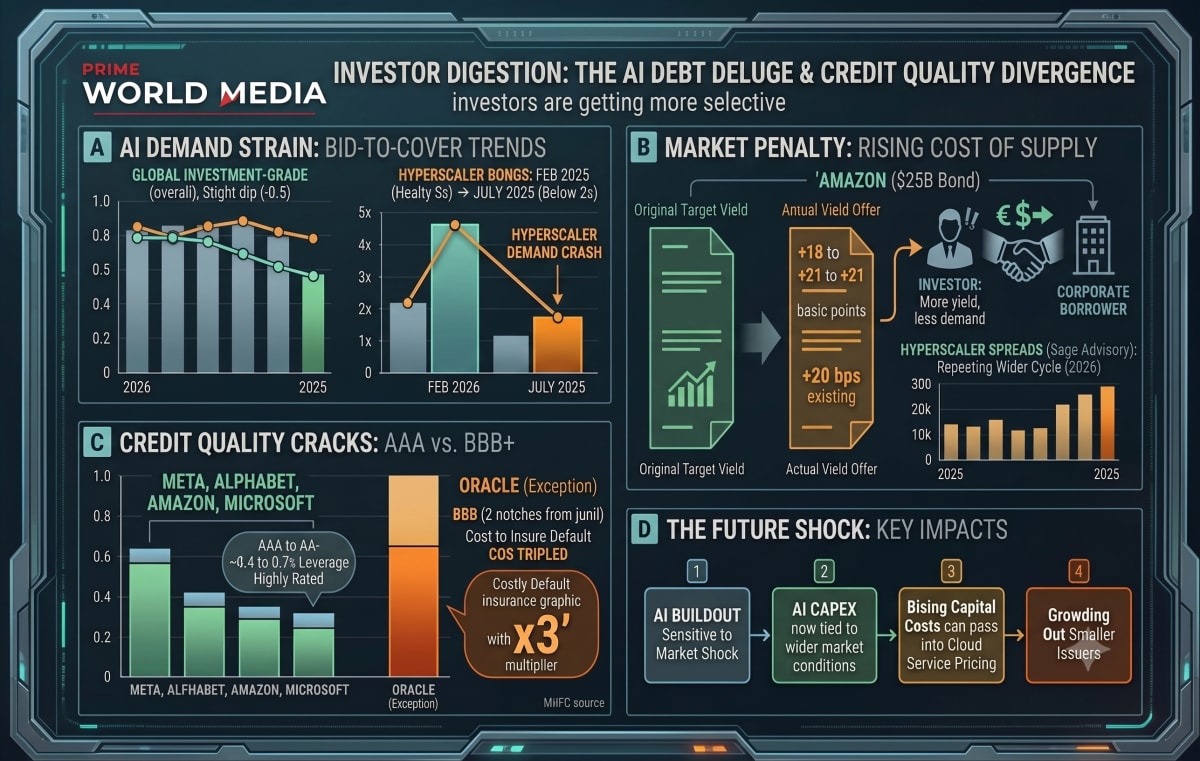
- Investor demand for this debt is showing real signs of strain: the bid-to-cover ratio (a measure of investor demand relative to bonds offered) for hyperscaler bonds fell from nearly 5x in February 2026 to below 2x by July 2026, and Amazon had to offer extra yield to complete a $25 billion bond sale.
- Not all hyperscaler credit is being treated equally by the market: Oracle's cost to insure its debt against default has more than tripled since September 2025, and its credit rating sits at BBB — two notches from junk — while Microsoft, Alphabet, Meta, and Amazon remain rated in the A to AA range.
The scale of the shift, in numbers
For most of the past decade, hyperscalers — the largest cloud and AI infrastructure companies — financed their growth primarily through cash generated by their own operations, rarely needing to borrow at scale. That's changed sharply and recently. The five largest hyperscalers issued $121 billion in U.S. corporate bonds in 2025 alone, more than four times their $28 billion average annual issuance between 2020 and 2024. Bank of America has repeatedly revised its 2026 forecast upward as the pace accelerated further — raising its full-year hyperscaler issuance projection from $140 billion to $175 billion after Amazon alone issued approximately $54 billion in bonds across dollar and euro markets in a single offering in March 2026.
The broader picture is even larger once the full AI ecosystem is included. Since the start of 2025, Alphabet, Meta, Amazon, and Oracle alone have issued more than $300 billion in bonds, according to Bloomberg's calculations. Nvidia, the dominant AI chip maker, issued $25 billion in bonds in one recent month — its first bond sale in five years. SpaceX, now positioned as an AI infrastructure player following its acquisition of xAI, sold $25 billion in bonds just days after a record $86 billion IPO. UBS estimates cumulative public debt for the core hyperscaler group could reach $230 billion to $240 billion by the end of 2026, and JPMorgan has forecast $375 billion in debt proceeds for the group from 2026 through 2030.
What's driving the borrowing: capital expenditures that keep climbing
The underlying cause is straightforward: capital expenditure for AI infrastructure has grown faster than even the hyperscalers' substantial free cash flow can fund internally. Microsoft, Meta, Amazon, and Alphabet collectively told investors they expect to spend approximately $700 billion on capital expenditures in 2026 — roughly double what the group spent in 2025. Separate reporting puts total 2026 capital expenditure for the "Big Five" hyperscaler group at more than $600 billion, with roughly 75%, or about $450 billion, specifically earmarked for AI-related infrastructure — data centers, specialized chips, and the power and networking capacity to support them.
That level of spending has visibly reshaped the broader corporate bond market. Technology's weighting in major investment-grade benchmarks, including the Bloomberg US Corporate Index, has climbed to roughly 10%, up from about 7% in 2025 and just 1% to 3% during the 2020–2024 period — and in several major indices, technology borrowers have now overtaken banks in overall weight for the first time. Barclays forecasts total U.S. corporate bond issuance will reach $2.46 trillion in 2026, up 11.8% from 2025, with AI-related funding cited as the single biggest driver of that increase; net issuance is projected to rise 30.2% to $945 billion.
The credit quality argument, and where it's starting to show cracks
For most of this borrowing wave, the dominant market narrative has been reassuring: these are among the most creditworthy companies in the world, borrowing to fund genuinely productive infrastructure, at leverage levels far below typical corporate norms. Even after absorbing significant new debt, most hyperscalers are expected to carry leverage of roughly 0.4 to 0.7 times, according to M&G Investments — compared with an average of just under three times for the broader U.S. investment-grade market. Microsoft holds a AAA credit rating, Alphabet AA+, and Meta and Amazon both sit at AA-, placing all four among the most highly rated corporate borrowers globally.
Oracle is a clear exception to that reassuring picture, and worth tracking separately from the other four. Oracle's credit rating sits at BBB — two downgrades below the other major hyperscalers, and only a few notches above junk status — and the cost to insure its debt against default through credit default swaps has more than tripled since September 2025, according to MUFG. That divergence is a useful reminder that "hyperscaler debt" isn't a single uniform credit story; individual issuer fundamentals still matter significantly within the broader borrowing wave, and Oracle's specific credit trajectory is being watched more closely by the market than its four larger peers.
The demand-side signal that's changed most recently: investors are getting more selective
The more recent and arguably more significant development isn't the volume of debt being issued — it's a clear softening in investor appetite to absorb it. A closely watched measure of investor demand, the bid-to-cover ratio (which compares the total value of investor orders received to the value of bonds actually being sold), fell from nearly 5 times in February 2026 to below 2 times by July 2026 for hyperscaler bond offerings — a meaningfully sharper decline than the roughly half-point slippage seen across investment-grade bonds overall in the same period. One analyst characterized the shift as suggesting investors may need wider spreads — meaning higher relative yields — to keep absorbing the growing volume of hyperscaler supply.
That shift showed up concretely in Amazon's most recent bond sale: the company had to sweeten what was described as a "surprise" $25 billion offering by adding 18 to 21 basis points of extra yield on its longest-dated debt to attract sufficient buyer interest — and the new issuance pushed the pricing on Amazon's existing 30-year bond, issued earlier in the year, roughly 20 basis points wider as well, indicating the effect extended beyond just the new deal itself. Sage Advisory's analysis of the pattern describes each successive large hyperscaler bond deal as pressuring spreads wider before eventually stabilizing — a repeating cycle that has become the primary driver of hyperscaler bond underperformance relative to the broader investment-grade market in 2026.
Why this matters even if you don't invest in corporate bonds directly
This shift is relevant well beyond fixed-income investors specifically. If the largest AI infrastructure companies are increasingly financing their buildout with debt rather than purely from operating cash flow, and if the market is starting to demand higher compensation to keep absorbing that debt, borrowing costs for the entire AI buildout become more expensive over time — a cost that, directly or indirectly, factors into how quickly and how aggressively these companies can continue expanding AI infrastructure capacity, and ultimately into the pricing of the cloud AI services built on top of it. It also means the AI capital expenditure boom is now genuinely intertwined with broader credit market conditions in a way it wasn't as recently as 2024 — a shock to investment-grade credit markets more broadly, for reasons unrelated to AI specifically, could now have a more direct transmission channel into AI infrastructure financing than it would have a few years ago.
There's also a market-structure dimension worth understanding: as hyperscalers absorb an increasingly large share of investment-grade bond issuance, they can effectively crowd out smaller or lower-rated issuers competing for the same pool of investor capital — a dynamic that extends this story's relevance to corporate borrowers well outside the technology sector.
What this means if you're planning around AI infrastructure costs or evaluating AI-sector exposure
- Don't assume AI infrastructure buildout is being funded purely from tech giants' cash reserves. A meaningful and rapidly growing share is now debt-financed, which means the pace of that buildout is, for the first time in this cycle, genuinely sensitive to broader credit market conditions and investor risk appetite, not just to the companies' own capital allocation decisions.
- Treat "hyperscaler" as a category with real credit-quality variation, not a single uniform risk profile. Oracle's tripling credit-default-swap costs and lower BBB rating stand in clear contrast to Microsoft's AAA rating and Alphabet's, Meta's, and Amazon's AA-range ratings — a business evaluating exposure to this sector, directly or indirectly, should treat individual issuer fundamentals as materially different from one another.
- Watch bid-to-cover trends as an early signal, not just headline issuance volume. The steep decline in investor demand relative to bond supply between February and July 2026 is arguably a more forward-looking signal about market conditions than the growing dollar volume of bonds issued, which by itself doesn't indicate whether that debt is being absorbed easily or with increasing difficulty.
- Recognize that rising hyperscaler borrowing costs could eventually show up in AI service pricing. While no direct, immediate pass-through has been established, a structurally more expensive cost of capital for the companies building the AI infrastructure layer is a cost factor worth monitoring over a multi-year horizon, alongside the more immediate hardware and software pricing dynamics already playing out in the AI market.
Frequently Asked Questions
Does rising hyperscaler debt issuance mean these companies are in financial trouble? Not based on current credit ratings and leverage metrics — most hyperscalers carry leverage well below typical investment-grade corporate norms and hold some of the highest credit ratings available. The relevant story here isn't distress, but a structural shift in how AI infrastructure is being financed, combined with early signs that investor demand for this debt is becoming more selective and requiring higher compensation.
Why would companies with strong cash flow choose to borrow rather than pay for AI infrastructure directly? Even hyperscalers' substantial operating cash flow hasn't kept pace with the scale of AI-related capital expenditure growth — with combined 2026 capex for the largest players roughly doubling from 2025 levels. Borrowing at historically low relative rates for creditworthy issuers, rather than depleting cash reserves or slowing infrastructure buildout, has been the preferred approach across the sector.
Is Oracle's credit situation a sign the broader AI infrastructure debt trend is unsustainable? Oracle's specific credit trajectory — including its tripling credit-default-swap costs and BBB rating — is generally treated by market analysts as a company-specific credit story rather than evidence of sector-wide distress, given that Microsoft, Alphabet, Meta, and Amazon continue to carry considerably stronger credit ratings and lower leverage. It's a useful reminder that individual issuer fundamentals vary meaningfully within the broader hyperscaler borrowing trend, rather than a signal to extrapolate uniformly across the group.
What would it take for hyperscaler borrowing costs to rise significantly from here? Based on the demand-side trends described above, continued high issuance volume combined with softening investor appetite — reflected in falling bid-to-cover ratios — would be expected to push spreads (and therefore borrowing costs) wider over time, a dynamic that was already visible in Amazon's need to offer additional yield to complete its most recent large bond sale.
Sources & References
- Fortune / Yahoo Finance, "The AI boom is increasingly built on debt, but investor demand is plunging just as hyperscalers ramp up their bond blitz" (July 17, 2026)
- Reuters, "AI hyperscalers will drive higher US corporate bond supply in 2026, analysts say" (January 15, 2026)
- Quartz, "Tech hyperscalers are displacing banks as top U.S. [bond issuers]" (May 8, 2026)
- Vanguard, "The AI buildout comes to the bond market"
- Neuberger Berman, "How SpaceX and AI Spending Are Reshaping Investment Grade Credit"
- Sage Advisory, "Hyperscaler Debt Deluge: The New Driver of IG Spread Pressure"
- Seeking Alpha, "$40T debt bubble meets AI boom: Hyperscalers grab 9% of IG credit supply" (August 21, 2026)
Related Reading
For a look at how this same AI infrastructure boom is playing out on the hardware pricing side, see PrimeWorldMedia's coverage of Nvidia's AI server price increases — together, the two stories show rising costs showing up on both the equipment side and the financing side of the same AI buildout simultaneously.
Alexander Wright
Alexander Wright is the Senior Editorial Lead at Prime World Media. Dedicated to delivering precise, high-impact investigative journalism and executive-level business insights from around the globe.