Tesla's Optimus Robot Has Finally Started Production — But the Real Story Is How Slow It's Going
Written By
Sam Mishara
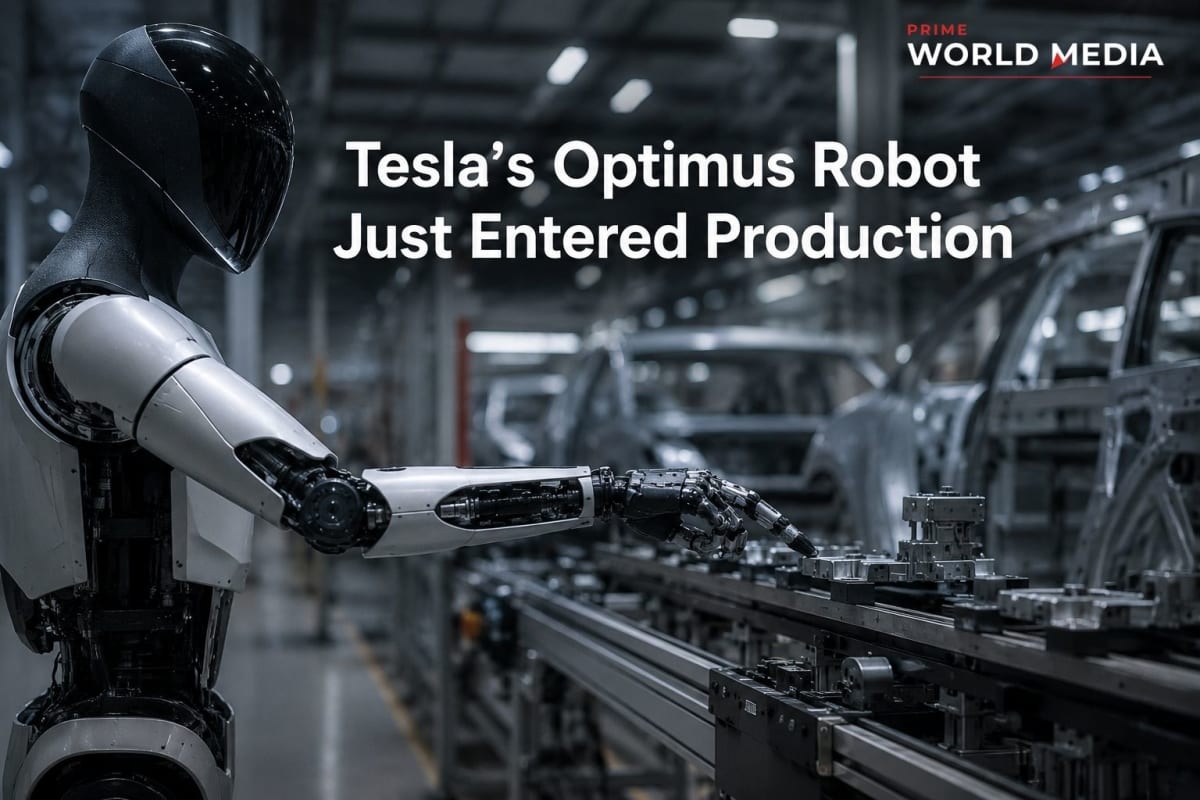
Tesla's Optimus Robot Has Finally Started Production — But the Real Story Is How Slow It's Going
This article summarizes company statements and industry reporting on Tesla's Optimus program. Production figures for the program remain largely unverified by independent sources, as Tesla has not published official unit counts.
Key Takeaways
- Tesla's Optimus humanoid robot entered its full-body production phase at the company's Fremont, California factory in late August 2026, confirmed as part of the company's broader announcements around August 31.
- The Fremont line occupies the same factory space that built the Model S and Model X for 14 and 11 years respectively, before those vehicles' production ended in early May 2026 to make room for the conversion.
- CEO Elon Musk has repeatedly cautioned that initial output will be slow, describing the production ramp as "impossible to predict" given that Optimus involves roughly 10,000 unique parts across an entirely new manufacturing line.
- Tesla's track record on Optimus production targets has consistently fallen short: the company aimed for 5,000 units for internal factory use in 2025 but reportedly produced only a few hundred, well under 10% of that goal.
- A second, larger Optimus factory is under construction at Giga Texas, targeting the higher-volume Gen 4 variant with a long-term design capacity of 10 million units annually, with production expected to begin around summer 2027.
What actually started this week
Tesla confirmed that Optimus production at Fremont moved into its full-body manufacturing phase in the late July-to-August 2026 window that Musk had guided toward on the company's Q1 2026 earnings call back in April. The timeline was aggressive by design: the last Model S and Model X vehicles rolled off Fremont's line in early May 2026, ending a 14-year production run for the Model S and an 11-year run for the Model X, and Tesla moved to convert that same physical space into what it's positioning as the world's first large-scale humanoid robot production line.
Musk shared visual confirmation of the transition's progress in July, posting a photo of himself with the Optimus production team inside the converted Fremont facility. Tesla's own public framing describes the moment as "installing the first-generation lines for Optimus," with production expected to start soon after — language notably more measured than some of Musk's earlier, more ambitious public predictions for the program.
Why "started production" doesn't mean what it might sound like
It's worth being precise about what's actually happening at Fremont right now, because the gap between Tesla's stated targets and its actual delivery record on Optimus has been significant. Musk predicted in January 2025 that Tesla would build "roughly 10,000" Optimus robots that year — a target the company missed entirely. By January 2026, Musk himself acknowledged that zero Optimus robots were doing "useful work" in Tesla's factories at that point, and reporting from The Information indicated the company's actual 2025 output was only a few hundred units against an internal goal of 5,000, a shortfall Tesla has attributed partly to China's April 2025 export restrictions on rare earth magnets and a longer-than-planned finalization of the Gen 3 design, particularly its dexterous hand system.
Given that history, Musk's own caution about the current ramp is worth taking seriously rather than dismissing as standard corporate hedging: he has specifically warned that scaling Optimus will be "harder than any manufacturing program" Tesla has attempted, and that the production rate for 2026 is "literally impossible to predict" given the newness of the line and the sheer part count involved.
What the robot can actually do right now
As of Tesla's most recent public updates, Optimus units operate inside Tesla's own Fremont and Austin factories on tasks including battery module handling, parts kitting, and assembly assistance — internal deployment aimed at both real productivity and, significantly, generating the training data Tesla needs to improve the robot's capabilities. Tesla has described this as an approach modeled directly on its Full Self-Driving program: an end-to-end AI system that converts camera input directly into physical action, trained on internet video, human demonstrations, and data from Tesla's own factory floor through what the company calls its Optimus Academy.
The current hardware generation, Gen 3, reportedly features hands with 50 actuators and 22 degrees of freedom, a roughly 2.3 kWh battery, and Tesla's own AI5 chip for on-device processing, paired with xAI's Grok system for voice-based natural language instruction. Tesla has been explicit that, as of now, there is no public sale, deposit, or waitlist program for Optimus — the company has specifically flagged any claims of being able to "pre-order" or "invest in" Optimus directly as scams.
The bigger industrial bet behind the robot
Musk has described Optimus as potentially Tesla's largest project ever, built on the argument that the company's existing vertical integration, AI expertise, and car-manufacturing experience give it an advantage in scaling humanoid robots the way it scaled electric vehicles. The Fremont line is designed for an eventual capacity of 1 million Optimus units annually, while the planned Giga Texas facility — under construction on the site's north campus expansion — is targeting a considerably larger long-term design capacity of 10 million units per year for a more vertically integrated Gen 4 platform, with production there expected to begin around summer 2027.
The financial stakes attached to this bet are significant: some Wall Street projections put Tesla's 2026 free cash flow at negative $5.19 billion, a shortfall the company appears willing to tolerate specifically in anticipation of future Optimus-driven revenue. For context on the scale of ambition involved, one Deutsche Bank analyst estimate placed the entire humanoid robot market's potential at around 200,000 annual unit sales by 2035 — a figure Tesla's own stated targets aim to reach within 2026 alone, illustrating just how far outside current analyst consensus Tesla's public goals for the program sit.
Tesla isn't alone in this race
Competition in humanoid robotics has intensified alongside Tesla's efforts. Boston Dynamics has been shipping its electric Atlas humanoid to Hyundai factories, while China's Unitree reportedly ships more humanoid units than any Western competitor, at roughly a tenth of the price of leading platforms — though Unitree's own Q1 2026 profit reportedly fell by half despite that volume advantage. Separately, Figure AI and Agility Robotics are described in independent reporting as currently holding the strongest verified deployment records in the sector, ahead of Tesla's own confirmed numbers, a detail worth weighing against some of the more inflated third-party claims about Optimus deployment figures that have circulated without company confirmation.
What this means if you're following the story
- Treat "production has started" as a manufacturing-ramp milestone, not a market-readiness signal — Tesla's own guidance describes current output as feeding internal factory tasks and robot training, not external sales.
- Watch Tesla's next earnings call for a real production number, since the company has not published official Optimus unit counts and third-party estimates have varied widely and often unreliably.
- Weigh Tesla's stated targets against its actual track record on this specific program — the gap between Optimus goals and delivered output has been substantial in 2025, a pattern worth factoring into expectations for the current ramp.
- Distinguish between the Fremont line (1 million/year design capacity, active now) and the Giga Texas facility (10 million/year design capacity, not expected until summer 2027) when evaluating any headline production figures you encounter.
Frequently Asked Questions
Can I buy a Tesla Optimus robot right now? No. As of August 2026, Optimus is not available for public sale, and Tesla has stated there is no legitimate pre-order or investment program — any such offers should be treated as scams.
How many Optimus robots has Tesla actually built? Tesla has not published an official production count. Independent reporting has put cumulative builds in the low hundreds as of mid-2026, far below some widely circulated but unverified claims of tens of thousands of units.
What happened to the Model S and Model X to make room for Optimus? Tesla ended production of both vehicles in early May 2026 at the Fremont factory, closing out 14-year and 11-year production runs respectively, specifically to convert that line space for Optimus manufacturing.
When will there be a larger, higher-volume Optimus factory? Tesla is constructing a second facility at Giga Texas targeting the higher-volume Gen 4 variant, with production expected to begin around summer 2027 and a long-term design capacity of 10 million units per year.
Sources & References
- Electrek, "Tesla pushes Optimus V3 reveal later this year — again" (April 2026)
- Teslarati, "Tesla Optimus project fires up as Musk sees production line progress" (July 2026)
- Technology.org, "Humanoid Robots in 2026: What Is Actually Deployed" (July 2026)
- The AI Insider, "Musk Updates Progress of Tesla's Optimus Humanoid Robot, Warns of Initial 'Long and Flat' Production Ramp" (July 2026)
- TheStreet, "Stock Market Today (Aug. 31, 2026)" — Tesla stock reaction to Optimus production-phase confirmation
Sam Mishara
Sam Mishara is a regular contributor and industry expert at Prime World Media, covering market innovations and leadership strategies.